Dry Granulation VS Wet Granulation: Granulation Methods Compared
Granulation is a key process step in the pharmaceutical, food and chemical industries. Granulation not only improves the homogeneity and flowability of the product, but also improves the appearance and usability of the product. Choosing the right granulation method - dry or wet - can significantly impact productivity, product quality and operating costs. This article explores the core differences, benefits and applications of dry and wet granulators to help companies make informed decisions.
What is Dry Granulation?
Dry granulation is a method where powders are compressed into granules without using a liquid binder. This is achieved using high-pressure equipment such as roller compactors or slugging presses.
How it works:
l The material is compressed into dense sheets or slugs.
l These are then milled into uniform granules of the desired size.
Equipment Used:
l Roller compactors.
l Oscillating granulators for breaking down sheets into granules.
Common Applications:
l Pharmaceutical tablets that are sensitive to moisture or heat.
l Chemical powders requiring dense granules.
l Products with ingredients that degrade in the presence of solvents.

What is Wet Granulation?

Wet granulation involves adding a liquid binder to powders to form granules. The process typically requires additional drying to achieve the desired granule stability.
How it works:
l A liquid solution or binder is mixed with the powder to create a dough-like consistency.
l The mixture is processed through a granulator to form granules.
l The granules are dried using fluidized beds or tray dryers.
Equipment Used:
l High-shear mixers for uniform binding.
l Fluidized bed granulators for drying and shaping.
l Spray granulators for continuous processes.
Common Applications:
l Food products like instant powders and drink mixes.
l Pharmaceuticals requiring uniform granule size and consistency.
l Products benefiting from high binding strength.
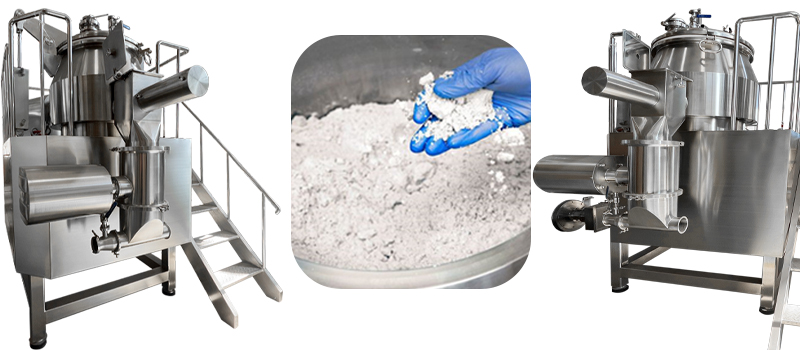
Comparison of application scenarios
1. Pharmaceutical industry: Dry granulators and wet granulators have their own advantages. Dry granulators are suitable for moisture-sensitive drugs, such as vitamins and certain antibiotics; wet granulators are suitable for drugs that require high uniformity and high molding effect, such as tablets and capsules.
2. Food industry: dry granulator is suitable for humidity-sensitive food materials, such as coffee and tea; wet granulator is suitable for food products requiring high uniformity and high molding effect, such as milk powder and beverage powder.
3. Chemical industry: dry granulator is suitable for humidity-sensitive chemical raw materials, such as catalysts and some chemical reagents; wet granulator is suitable for high uniformity and high molding effect of chemical products, such as coatings and fertilizers.
Taken together, dry granulator and wet granulator have their own advantages and disadvantages and are suitable for different application scenarios. Dry granulator has obvious advantages in high efficiency and energy saving, stability of finished products, easy operation and environmental protection, which is suitable for humidity-sensitive materials and high efficiency production needs; wet granulator has advantages in granulation effect, particle uniformity and scope of application, which is suitable for products with higher requirements on granulation effect and particle uniformity.
- Contact us today for more information.