Energy Transfer in Dual Chamber Freeze-Drying Explained
In the biopharmaceutical industry, lyophilized (freeze-dried) formulations play a critical role in ensuring product stability and extending shelf life. However, most lyophilized products cannot be administered directly with a standard syringe because they require a reconstitution step prior to injection. For home care and emergency use, this extra step is often seen as a barrier.
To address this challenge, the Dual Chamber System (DCS) has emerged as a promising solution. By enabling on-site reconstitution and injection within a single device, DCS provides greater convenience, safety, and efficiency. Although only a few products are currently available on the market due to technical and economic challenges, DCS is expected to grow significantly and may become the preferred choice for emergency medicine and home healthcare.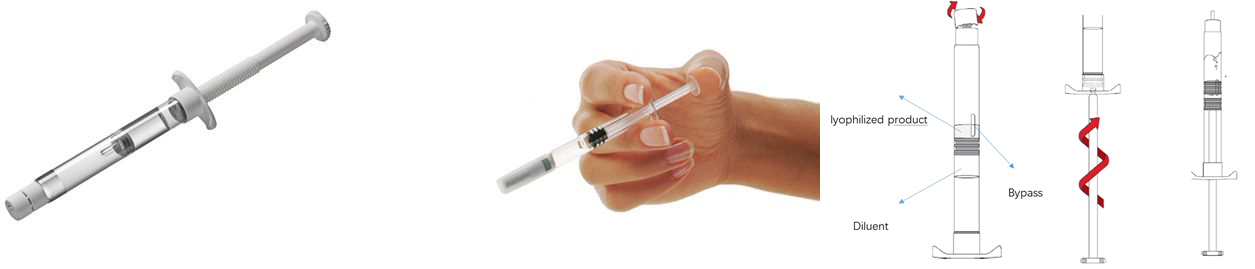
1. What is the Dual Chamber System (DCS)?
The Dual Chamber System integrates two separate chambers within a single prefilled syringe or cartridge:
-
One chamber stores the freeze-dried active ingredient.
-
The other chamber contains the diluent solution.
At the time of use, the plunger is pushed, displacing the middle stopper and allowing the diluent to flow into the lyophilized chamber. After mixing, the solution can be immediately administered.
This design combines the storage stability of lyophilized medicines with the ease of use of liquid prefilled syringes.
2. The Role of Freeze-Drying (Lyophilization)
Freeze-drying is a process where frozen material is dried under vacuum, allowing the solvent (usually water) to sublimate directly from solid to vapor phase. This gentle drying method preserves the original chemical structure and biological activity of sensitive materials such as proteins, peptides, and vaccines.
Benefits:
-
Preserves biological activity after reconstitution
-
Minimizes degradation during storage
-
Extends shelf life without refrigeration in some cases
3. Energy Transfer in DCS Freeze-Drying
Unlike conventional vials, dual chamber prefilled syringes have a unique geometry:
-
Small contact area between syringe and shelf surface
-
Energy transfer occurs mainly via convection and radiation rather than conduction
Energy contribution by phase:
-
Freezing stage: Convection > Radiation > Conduction
-
Drying stage: Radiation > Convection > Conduction
This means that temperature control is indirect, and modifications such as using a metal sleeve can improve heat conduction. Alternative workflows, such as allowing the syringe body to contact the freeze dryer shelf, show slower cooling rates (~40% slower than vials) and higher final freezing temperatures (+8.2°C compared to the shelf).
Thus, design space exploration—considering packaging materials, formulation composition, fill volume, and process parameters—is critical in development, scale-up, and tech transfer.
4. Manufacturing Challenges & Considerations
Despite its advantages, dual chamber prefilled syringe manufacturing faces challenges:
-
Complexity of freeze-drying due to geometry and heat transfer limitations
-
Sterility assurance during assembly and lyophilization
-
Limited fill volumes (commonly 1–5 mL) due to syringe capacity
-
Higher production costs compared to conventional vial lyophilization
Advanced pilot freeze dryers with separated drying chamber and condenser, silicone oil as heat transfer medium, and efficient defrosting systems have been developed to improve process speed, reduce energy consumption, and simplify cleaning.
5. Market Applications and Future Outlook
Currently, only a handful of pharmaceutical companies offer DCS lyophilized injectables, but the market potential is significant:
-
Emergency medicine: Ready-to-use format for critical conditions
-
Home healthcare: Simplified self-administration without specialized training
-
Biopharmaceuticals: Especially useful for monoclonal antibodies, peptides, and vaccines requiring stability
As freeze-dried biologics continue to dominate new approvals, demand for DCS technology is projected to rise. With improvements in manufacturability and cost efficiency, dual chamber prefilled syringes could transform medicine delivery in both hospital and at-home settings.
Conclusion
The Dual Chamber System (DCS) represents a major innovation in injectable medicine delivery by merging the benefits of lyophilized formulations with the convenience of prefilled syringes. While technical and economic hurdles remain, DCS offers significant advantages in safety, usability, and patient compliance. As manufacturing technologies evolve, dual chamber syringes are likely to play an increasingly important role in the future of biopharmaceutical delivery systems.
- Contact us today for more information.