Granulation Problems and Tablet Quality
Tablet manufacturing is a delicate balance of material properties, process parameters, and equipment performance. Among these, the physical defects—such as soft tablets, capping, cracking, or sticking—often originate from the raw material characteristics and improper process settings. Understanding these causes is essential to ensure consistent tablet quality and production efficiency.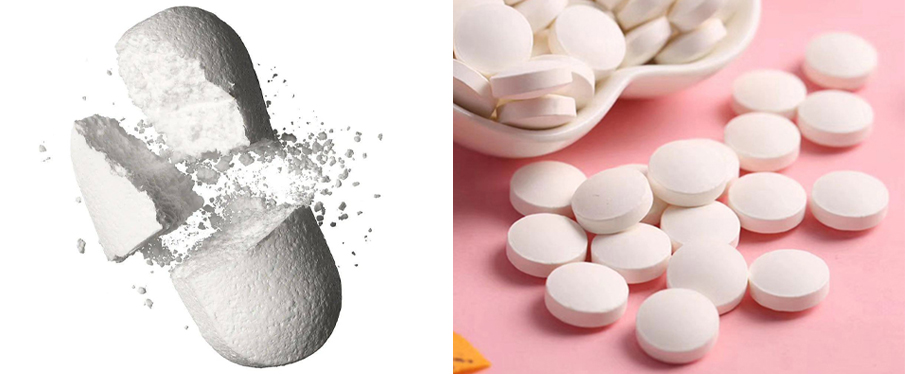
1. Material-Related Causes: The Foundation of Tablet Quality
The formulation and material properties form the foundation of tablet integrity. If materials lack appropriate flowability, compressibility, or binding properties, physical defects will inevitably appear during compression.
1.1 Poor Flowability
Uneven granule size or excessive fine powder reduces material flowability, resulting in unstable die filling. This variation leads to weight deviation and soft tablets due to insufficient filling.
1.2 Low Compressibility
Crystalline or brittle materials often exhibit poor plastic deformation under pressure. As a result, interparticle bonding is weak, leading to lamination or tablet breakage during ejection.
1.3 Improper Binder or Excipient Ratio
- Too little binder → weak adhesion, causing soft or friable tablets.
- Excessive binder → delayed disintegration.
- Overused lubricant (e.g., magnesium stearate) → forms an isolating layer, weakening bonding and reducing dissolution rate.
- Incorrect disintegrant dosage → affects tablet hardness and disintegration time.
Proper selection and balance of excipients are crucial to achieving mechanical strength without compromising disintegration or dissolution.
2. Process-Related Causes: The Direct Impact on Tablet Defects
Process parameters during granulation, drying, and compression have a direct influence on tablet quality. Poor control can amplify material-related weaknesses.
2.1 Granulation Defects
- Wet granulation: Uneven binder addition leads to overly hard or soft granules. Hard granules → cracking, soft granules → sticking/picking.
- Dry granulation: Inadequate roller pressure results in low-density granules and soft tablets; excessive pressure causes hard granules and poor disintegration.
2.2 Improper Drying Conditions
Over-drying: Granules become too brittle, generating fines and causing weight variation or capping.
Under-drying: Residual moisture promotes sticking, color change, and microbial growth during storage.
2.3 Compression Parameters
Compression speed, pre-compression, and main pressure all influence final tablet quality:
- Too fast speed → poor air release → cracking/capping.
- Low pressure → soft tablets.
- High pressure → lamination or excessive hardness.
- Uncontrolled humidity → high moisture causes sticking, low humidity causes static, affecting powder flow.
Conclusion
Most tablet defects can be traced back to material inadequacies and process mismanagement. Optimizing granule characteristics, controlling moisture content, and fine-tuning compression parameters can significantly improve yield and quality consistency.
- Contact us today for more information.