How can freeze-drying technology be used to achieve long-term preservation of red blood cells?
Why Freeze-Drying Matters for Red Blood Cell Preservation
Red blood cells are highly susceptible to oxidation and degradation. Many of their functional components cannot survive long-term in conventional storage environments. Freeze-drying solves this issue by removing intracellular water, minimizing oxidative stress and contamination, while maintaining the cell's viability and characteristics.
Working Principle and Features of a Laboratory Freeze Dryer
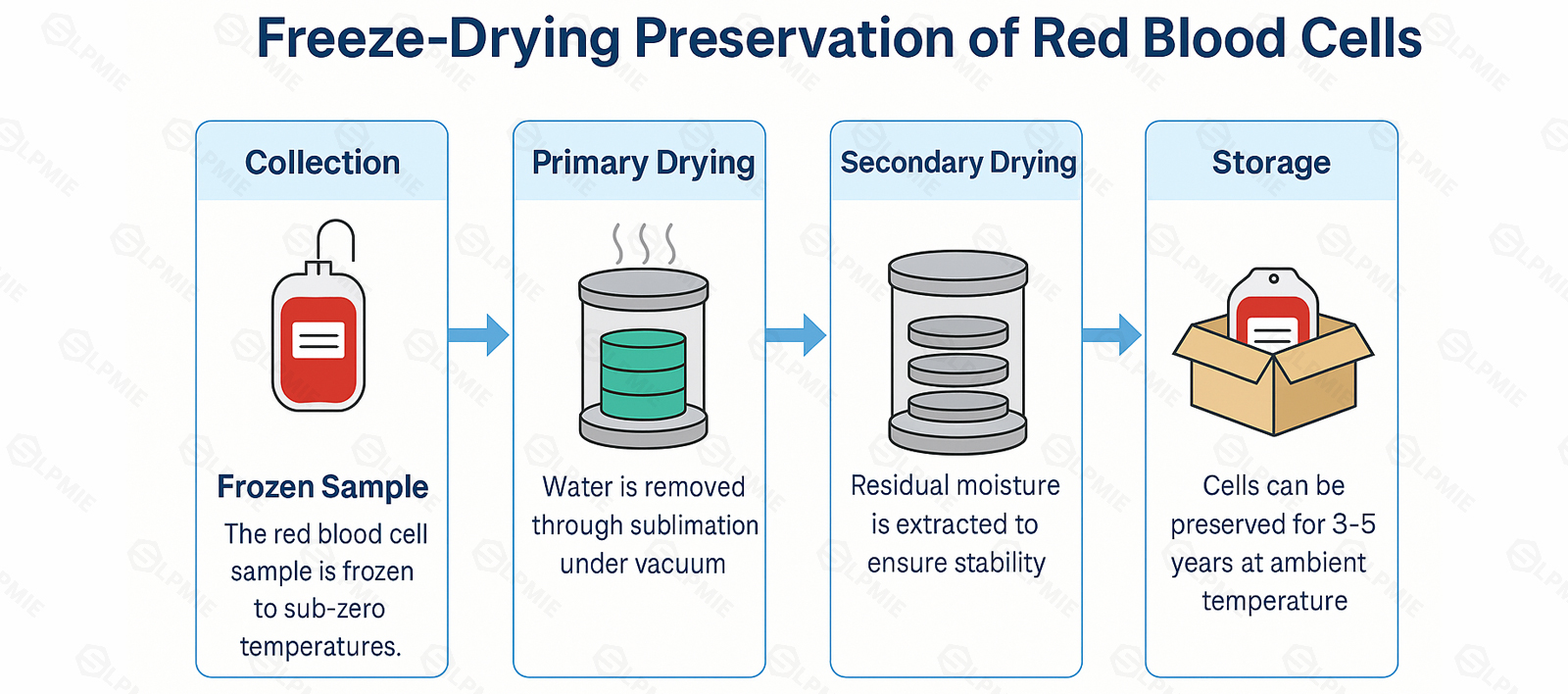
A freeze dryer operates by freezing the sample and then removing water via sublimation under vacuum. The process consists of:
- Freezing: The RBC sample is frozen at sub-zero temperatures;
- Primary Drying (Sublimation): Ice transitions directly to vapor under vacuum;
- Secondary Drying (Desorption): Residual moisture is removed to ensure stability.
Key Features:
- Precise temperature and pressure control;
- Fully automated cycle programming;
- Real-time sample monitoring;
- Suitable for lab-scale and pilot-scale production.
Benefits of Freeze-Drying Red Blood Cells
1. Preserving Membrane Integrity
The RBC membrane consists of lipids, proteins, and sugars that determine cell function. Freeze-drying helps retain membrane structure by preventing heat damage or osmotic rupture.
2. Extending Storage Time
Room temperature storage: ~3 days
Refrigeration: ~6–8 weeks
Freeze-dried RBCs: 3–5 years
This makes freeze-drying ideal for blood banks and emergency stockpiling.
3. Easier Transportation
Unlike refrigerated storage, freeze-dried samples are compact and do not require cold-chain logistics, significantly reducing transport complexity and cost.
4. Maintaining Cell Morphology
Since freeze-drying is performed under low-stress conditions, it prevents mechanical deformation during storage and shipment, preserving the cell’s original shape upon rehydration.
Conclusion
Freeze-drying offers a reliable and effective method for preserving red blood cells with minimal loss of structure and function. With its advantages in longevity, portability, and integrity preservation, this technology holds broad promise in transfusion medicine, biotechnology, and pharmaceutical fields. If you’re exploring long-term RBC storage solutions, freeze-drying is a cutting-edge option worth considering.
- Contact us today for more information.