Optimize Agitator Blade & Chopper Speed in Wet Granulation
In the wet granulation process, the speed of the agitator blade and chopper plays a crucial role in determining granule quality, particle size distribution, density, and flowability. Selecting the right speed ensures efficient mixing, prevents granule breakage, and optimizes downstream processing. Below is a detailed guide on how to adjust these speeds based on material characteristics and process requirements.

1. Agitator Blade Speed Selection

Function:
Key Considerations:
Too Low Speed: Leads to uneven mixing and large size variation in granules.
Too High Speed: May cause excessive shear force, leading to smaller or broken granules.
Selection Criteria:
✅ Material Characteristics:
High-viscosity materials (e.g., sugar-based or high-binder content) require lower speeds to avoid excessive agglomeration.
Low-viscosity materials (e.g., inorganic compounds or hydrophobic medicines) need higher speeds to facilitate granule formation.
✅ Target Granule Size:
For larger granules: Reduce speed to extend growth time.
For smaller granules: Increase speed to enhance shear force.
✅ Binder Addition Method:
When spraying binder, the agitator speed should synchronize with the spray rate to ensure even wetting.
2. Chopper Speed Selection
Function:
Key Considerations:
Too Low Speed: Causes granule clumping and broad particle size distribution.
Too High Speed: Produces excessive fine powder and rough granule surfaces.
Selection Criteria:
✅ Material Stickiness:
Sticky materials (e.g., gelatin or high-sugar content) require lower speeds to prevent fine powder formation.
Brittle materials (e.g., inorganic salts) can handle higher speeds for effective size reduction.
✅ Target Particle Size:
For finer granules (e.g., dispersible tablets): Increase chopper speed.
For coarser granules (e.g., sustained-release tablets): Decrease chopper speed.
✅ Coordination with Agitator Speed:
Chopper speed must match agitator speed to avoid ineffective cutting (e.g., if the chopper is too slow, it may not break up clumps properly).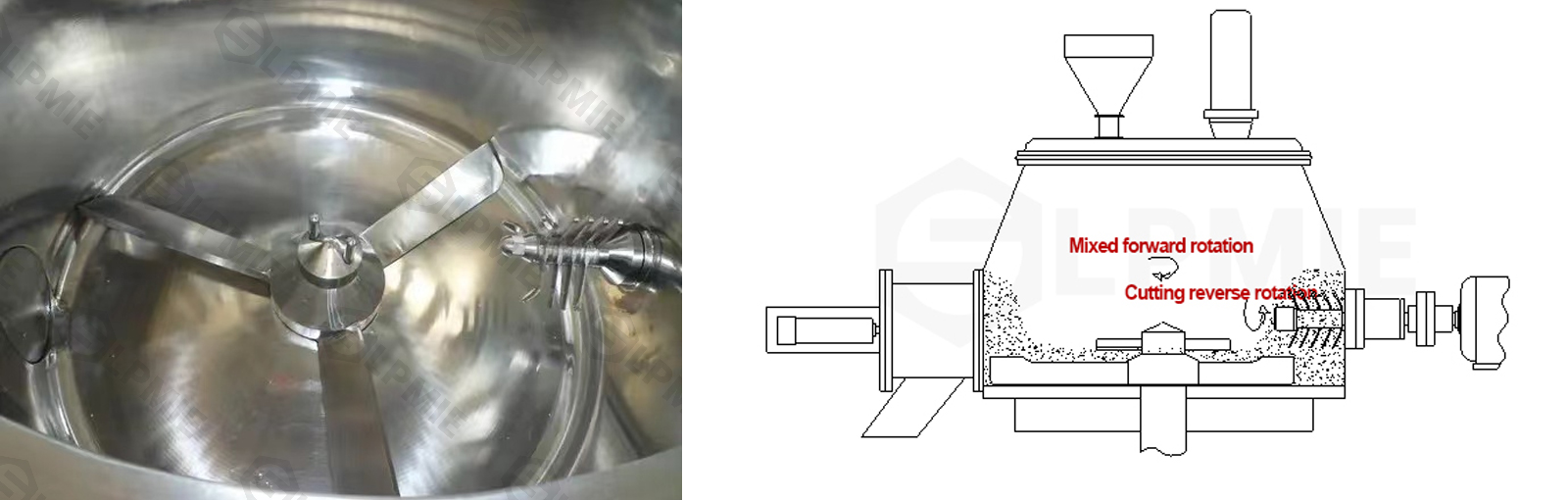
3. Speed Optimization Strategy
Initial Settings:
Agitator Blade Speed: Typically 30%-70% of the equipment’s maximum speed.
Chopper Speed: Generally 50%-80% of the maximum speed.
Example:
Step-by-Step Adjustments:
l If excessive fines are produced, reduce chopper speed or increase binder volume.
l If granules are too large or clumped, increase chopper speed or extend mixing time.
l Start by fixing the agitator speed based on material properties and target granule size.
l Gradually fine-tune chopper speed by observing the granule size distribution and flowability.
4. Real-World Application Tips
✅ Equipment Variability:
Different granulator models have unique speed-shear force relationships, so refer to equipment manuals and perform preliminary trials.
✅ Binder Concentration:
High-concentration binders may require higher speeds for even distribution.
✅ Temperature Management:
High-speed mixing generates heat, which can affect binder stability (e.g., PVP) and material integrity.
✅ Granule Drying:
Wet granules should be dried promptly to prevent binder migration or granule deformation.
5. Summary of Steps
l Define Goals: Determine granule properties based on tablet type (e.g., immediate-release, sustained-release).
l Set Initial Parameters: Choose agitator and chopper speeds based on material properties and equipment capabilities.
l Fine-Tune Adjustments: Analyze granule size, flowability, and compressibility to optimize settings.
l Finalize Process: Record optimal parameters and establish a Standard Operating Procedure (SOP).
By optimizing the agitator and chopper speed, manufacturers can enhance granule quality, ensure batch consistency, and improve the efficiency of downstream processes like tablet compression.
- Contact us today for more information.