By Crystal Li | 27 May 2025 | 0 Comments
Why Use One-Step Granulation in Tablet Production?
The one-step granulation tablet process refers to integrating mixing, granulating, and drying into a single machine to directly produce granules ready for tablet compression. This approach simplifies the workflow and offers both advantages and limitations.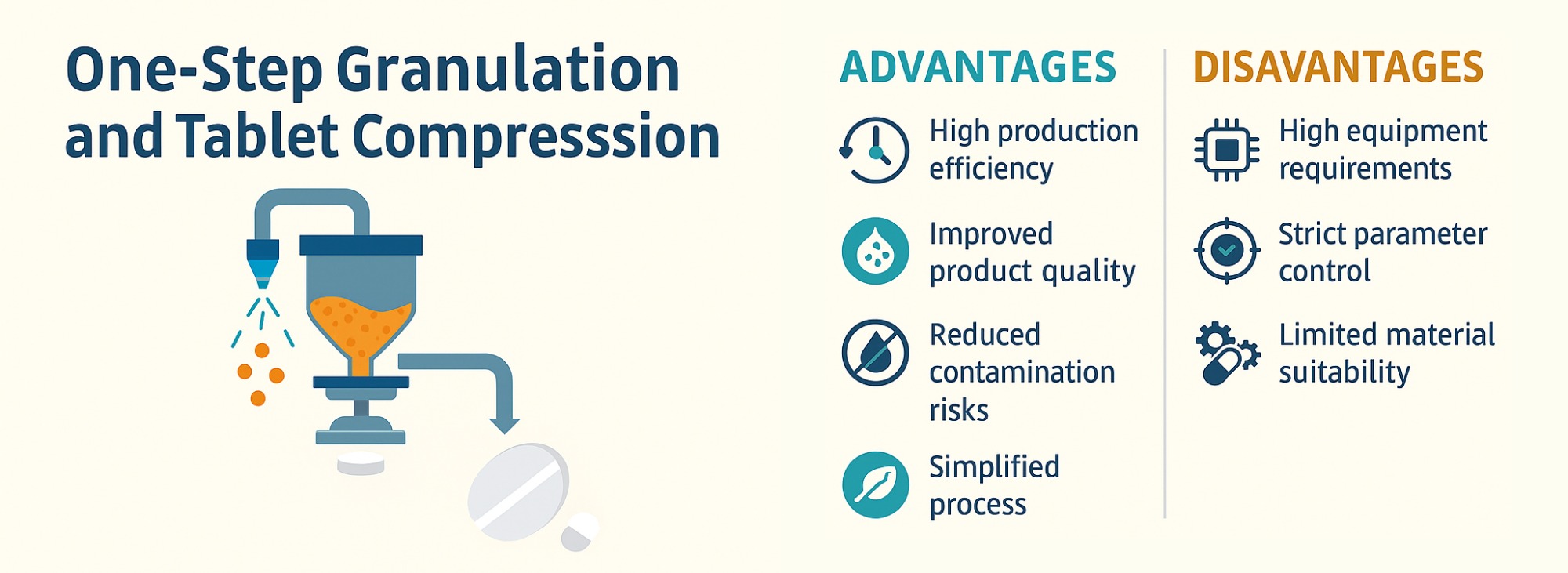
Advantages
- High Production Efficiency:By combining several conventional granulation steps into a single device, the process significantly reduces intermediate handling and shortens the production cycle. For instance, traditional wet granulation involves multiple steps (blending, wet massing, granulation, drying, sizing), while one-step granulation completes them in one go, saving both time and labor.
- Improved Product Quality:In the one-step process, materials are in a fluidized state, ensuring high mixing uniformity. The binder is sprayed evenly, producing granules with consistent size, excellent flowability, and strong compressibility. This leads to better tablet uniformity in weight, hardness, and appearance while reducing defects like chipping or lamination.
- Reduced Contamination Risk:Minimized material exposure and transfers lower the risk of external contamination, enhancing hygiene and meeting GMP (Good Manufacturing Practice) standards.
- Simplified Process:With fewer devices and reduced floor space, the investment and operational costs decrease. It also lessens operator workload and skill requirements, making process control and management easier.
Disadvantages
- High Equipment Requirements:This process requires specialized fluid bed granulators, which are structurally complex and expensive. Maintenance demands are higher, and equipment downtime can significantly affect production.
- Strict Process Parameter Control:Successful operation depends on precise control of material characteristics, binder type and dosage, spray rate, air temperature, and flow rate. Poor control can result in inconsistent granule size, improper moisture content, or poor flowability. For example, too much binder can harden granules and delay disintegration, while insufficient air flow can lead to under-drying.
- Limited Applicability:Some materials with high stickiness or poor flowability are not suitable for one-step granulation. Additionally, medicines sensitive to heat and moisture require careful temperature and humidity control to prevent degradation.
Conclusion
One-step granulation and tablet compression is a forward-thinking, efficient technique that combines multiple production stages into a unified workflow. It offers great advantages in speed, product quality, and hygiene control. However, it demands precise parameter tuning and specialized equipment, and is not suitable for all formulations. Manufacturers should weigh its benefits and limitations based on their specific needs.
Material Properties in Granulation Process
Optimize Agitator Blade & Chopper Speed in Wet Granulation
Leave a Reply
Your email address will not be published.Required fields are marked. *