The Role of Surface Area in Tablet Performance
The surface area of a tablet—more precisely the surface-area-to-volume ratio (SA/V)—is one of the most critical physical parameters in solid oral dosage design. It directly affects dissolution performance, chemical stability, mechanical strength, manufacturability, and ultimately bioavailability. Understanding how surface area behaves under different formulation and compression conditions is essential for ensuring consistent therapeutic outcomes and stable production. 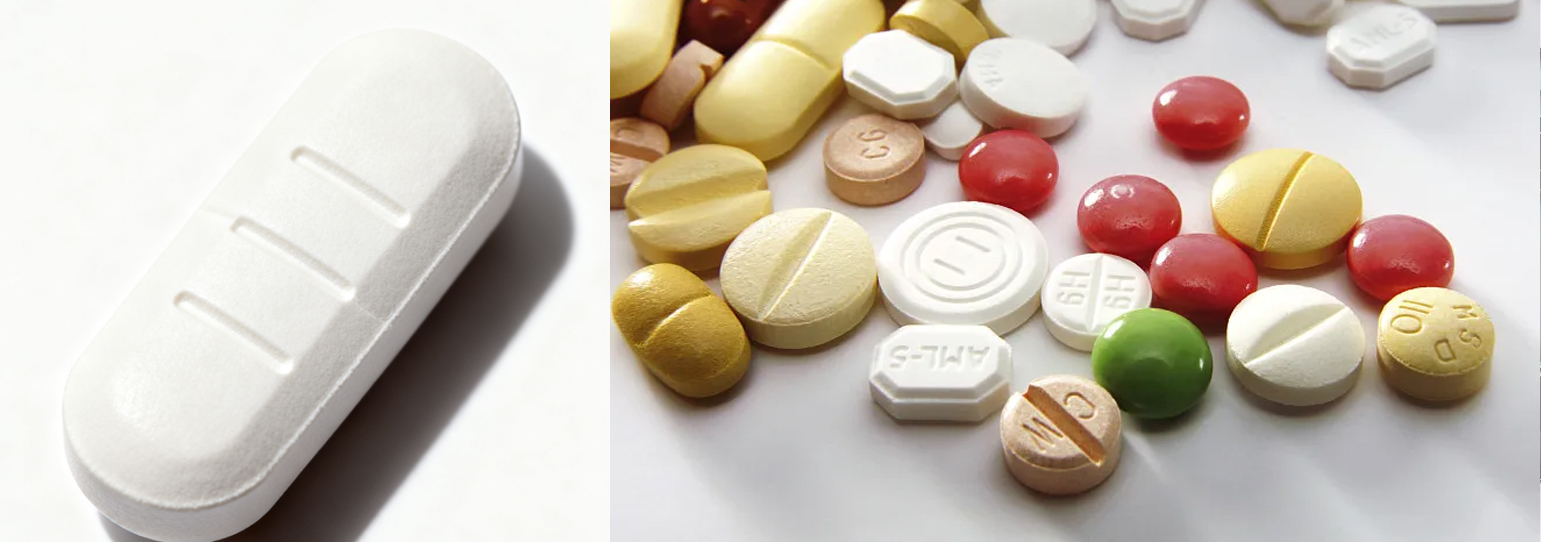
1. Effect of Surface Area on Dissolution Rate
Dissolution is the most surface-area–dependent parameter in tablet performance.
l Larger surface area → faster dissolution
More surface is in contact with gastric or intestinal fluids, promoting rapid drug release and shorter onset time.
l Smaller surface area → slower dissolution
A more compact, denser tablet reduces fluid penetration, creating a slower or controlled-release effect.
This is why immediate-release tablets benefit from higher surface area and porous structures, whereas sustained-release formulations intentionally design lower surface area and more compact matrices.
2. Effect of Surface Area on Chemical Stability
Higher surface area means more exposure to environmental factors such as:
l Oxygen
l Moisture
l Temperature fluctuations
A tablet with a large SA/V ratio is more prone to oxidation, hydrolysis, and degradation—leading to shorter shelf life.
In contrast, smaller surface area enhances stability because the drug and excipients are less exposed to air and humidity.
3. Effect of Surface Area on Mechanical Strength
Mechanical properties—hardness, friability, and resistance to chipping—are closely tied to tablet density and porosity.
l Large surface area (high porosity, loose structure)
Low hardness
Higher friability
Increased risk of chipping, lamination, or breakage
l Moderate surface area (denser internal structure)
Better mechanical integrity
Improved resistance to abrasion during coating, packaging, and transportation
Excessive porosity often reflects inadequate compression or improper granulation, both of which weaken structural cohesion.
4. Impact on Manufacturing Performance
Surface area correlates strongly with granule behavior during the tableting process.
Problems caused by excessive surface area
l High proportion of fines
l Increased adhesion risks → sticking and picking
l Poor flowability
l Uneven die filling → tablet weight variation
Problems caused by very low surface area
l Granules may become too dense
l Poor compressibility
l Higher compression force needed
l Increased risk of capping or lamination
Optimizing the SA/V ratio helps stabilize granule flow and reduces manufacturing defects.
5. Effect on Bioavailability
Because bioavailability is directly driven by dissolution rate, surface area indirectly determines how efficiently the drug is absorbed.
l Too small SA/V → slow dissolution → low or inconsistent bioavailability
l Too large SA/V → overly rapid dissolution → undesired peak concentration or dose dumping in controlled-release systems
Maintaining the appropriate surface area ensures consistent in vivo performance and minimizes batch-to-batch variability.
Common Abnormalities, Causes, and Correction Strategies
The table below summarizes how surface area deviations affect performance and how to correct them in formulation or manufacturing.
1. Dissolution Too Slow (Below Specification)
Cause: Surface area too small; tablet too dense with low porosity
Adjustment Options:
① Micronize or finely mill the API to increase SA/V
② Switch to porous excipients such as spray-dried lactose
③ Increase disintegrant quantity or use a more efficient grade
④ Reduce compression force to increase porosity
2. Dissolution Too Fast (Needs Slowing for Sustained Release)
Cause: Excessively large surface area; tablet porous or weakly compacted
Adjustment Options:
① Use high-density, strong wet granulation to reduce porosity
② Increase compression pressure
③ Add or thicken a sustained-release coating
④ Use denser excipients (e.g., crystalline lactose)
3. Tablet Chipping, Cracking, or High Friability
Cause: Surface area too large → high porosity, loose structure
Adjustment Options:
① Increase compression force to densify the tablet
② Modify granulation to enlarge particle size and reduce fines
③ Increase binder concentration to improve cohesion
4. Poor Stability (Oxidation, Hydrolysis)
Cause: Excessive surface area exposes large contact area to moisture/oxygen
Adjustment Options:
① Adopt dense granulation to lower porosity
② Add antioxidants or stabilizers
③ Use nitrogen-filled or vacuum packaging
④ Store under controlled humidity and temperature
5. Sticking, Picking, or Uneven Die Filling During Compression
Cause: Abnormal SA/V
l Too large → many fines → sticking and poor flow
l Too small → poor flow due to overly heavy granules
Adjustment Options:
① For large SA/V: reduce fines by screening or re-granulation
② For low SA/V: light milling to improve flowability
③ Adjust lubricant concentration
④ Maintain optimal humidity in compression room
6. Low or Highly Variable Bioavailability
Cause: Inconsistent or inappropriate surface area affecting dissolution
Adjustment Options:
① Adjust SA/V to match intended dosage form performance
② Narrow particle-size distribution
③ Optimize excipients to stabilize dissolution profile
Overall Importance of Surface Area Optimization
Balancing surface area is essential for achieving:
l Target dissolution performance
l Stable bioavailability
l Consistent tablet mechanical strength
l Smooth manufacturing and reduced defects
l Long product shelf life
In pharmaceutical development, SA/V must be controlled not only at the API level but also through granulation, compression, and coating processes.
- Contact us today for more information.