We use cookies to improve your online experience. By continuing browsing this website, we assume you agree our use of cookies.

Heavy-Duty Single Punch Tablet Press Machine | LPMIE

Item No.: 00433
The TDP-120D and TDP-180D Heavy-Duty Single Punch Tablet Presses are designed for large-diameter and thick tablets, offering up to 120–180 kN compression force and tablet diameters up to 60–75 mm.
  • Capacity2100 pcs/h
  • Power4.0 kw
  • Weight350 kg
  • Dimension620*700*850 mm
  • Description Technical Specifications Buying Guide & Support
    Description

    Product Overview

    The TDP-120D and TDP-180D Heavy-Duty Single Punch Tablet Press Machines are designed for applications requiring large tablet diameters, thick tablet forming and high compression force.

    Unlike conventional small single punch tablet presses used mainly for laboratory testing and small-batch production, these heavy-duty models are built for large-format tablet compression. They provide significantly higher compression force and larger tablet-forming capability, making them suitable for specialized pharmaceutical, food and chemical applications.

    The TDP-120D provides up to 120 kN of compression force and supports tablets up to 60 mm in diameter and 20 mm in thickness. The TDP-180D provides up to 180 kN of compression force and supports tablets up to 75 mm in diameter and 25 mm in thickness.

    The two models allow customers to select the appropriate machine according to tablet diameter, thickness, required compression force and production capacity.

    For customers comparing different types of tablet presses, see our guide: Tablet Press Machine Types: TDP, THDP, DP, ZP, ZPW and Heavy-Duty Models Explained. 

    Related Video


    Why Choose the TDP-120D / TDP-180D?

    Large Tablet Compression

    The TDP-120D and TDP-180D are specifically designed for large-format tablets that exceed the size range of conventional laboratory and small single punch presses.

    High Compression Force

    With maximum compression forces of 120 kN and 180 kN, the two models provide the force required for dense and difficult-to-form large tablets.

    Large Diameter Capability

    The TDP-120D supports tablet diameters up to 60 mm, while the TDP-180D supports up to 75 mm, making them suitable for specialized large tablet applications.

    Thick Tablet Forming

    With maximum tablet thicknesses of 20 mm and 25 mm, the machines can handle tablet formats that are difficult to produce on conventional tablet presses.

    Adjustable Compression Parameters

    Filling depth, tablet thickness and compression parameters can be adjusted according to the required tablet specification and formulation.

    Two Model Options

    The TDP-120D and TDP-180D provide different pressure and tablet-size capabilities, allowing customers to select the machine according to actual production requirements rather than simply choosing the highest-pressure model.

    Heavy-Duty Construction

    The robust machine structure is designed to withstand the higher loads associated with large-diameter and high-density tablet compression.

    Large tablet single-punch tablet press

    Typical Applications

    Industry

    Typical Applications

    Pharmaceutical

    Large pharmaceutical tablets, herbal tablets, specialized formulations

    Nutraceutical

    Large vitamin tablets, mineral tablets, nutrition tablets

    Food

    Milk tablets, candy tablets, nutrition blocks

    Chemical

    Cleaning tablets, catalyst tablets, compressed chemical products

    R&D & Pilot Production

    Development and testing of large-format tablet formulations

    Working Principle

    The TDP-120D and TDP-180D use a single-punch reciprocating compression process.

    The basic working cycle consists of four stages:

    1. Material Filling

    Powder or granulated material is fed into the die cavity. The filling depth determines the amount of material entering the die and therefore has a direct influence on tablet weight and thickness.

    2. Compression

    The upper punch moves downward and applies compression force to the material inside the die. The high-pressure structure of the machine allows large and thick tablets to be formed.

    3. Tablet Formation

    As the compression force reaches the required level, the powder or granules are compacted into the required tablet shape and density.

    4. Tablet Ejection

    After compression, the upper punch moves upward and the lower punch rises to eject the finished tablet from the die cavity. The cycle then repeats.

    Tablet diameter, filling depth, tablet thickness and compression requirements should be confirmed before selecting the appropriate model and tooling.

         A variety of cartoon-style tablets             Round purple tablets             High-thickness tablets

    Technical Specifications

    Technique parameter

    Requirement

    TDP-120D

    TDP-180D

    Maximum Pressure

    120 kN

    180 kN

    Maximum Tablet Diameter

    60 mm

    75 mm

    Maximum Tablet Thickness

    20 mm

    25 mm

    Production Capacity

    2,100 pcs/h

    1,800 pcs/h

    Machine Weight

    350 kg

    850 kg

    Recommended For

    Large tablets

    Extra-large / high-pressure tablets

    Buying Guide & Support

    How to Choose the Right Model?

    Generally speaking, the following parameters need to be confirmed for model selection:

    ① Confirm whether your powder is suitable for tableting.

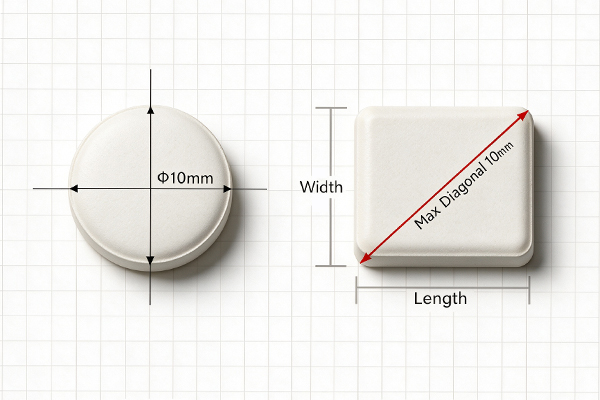
    ② Diameter of round tablets (the maximum diagonal length shall be provided for special-shaped tablets).

    ③ Required tablet thickness.

    ④ Required production capacity.

    Confirm the Tooling

    For large and special-shaped tablets, punch and die design becomes especially important.

    Need help choosing tablet tooling? → Tablet Shape Engineering: Balancing Design and Durability

    How to measure special-shaped tablets, comparison of Φ10mm round tablet and rectangular tablet with 10mm maximum diagonal length

    Complete Tablet Production Solution

    Equipment

    Function

    Powder Mixer

    Uniform powder mixing

    Vacuum Feeder

    Automatic powder feeding

    Tablet Press

    Tablet compression

    Tablet Deduster

    Remove tablet dust

    Metal Detector

    Metal contamination detection

    Tablet Counting Machine

    Automatic tablet counting

    Suitable Materials

    Material

    Suitable

    Pharmaceutical Granules

    ✔

    Vitamin Powder

    ✔

    Calcium Carbonate

    ✔

    Herbal Extract Powder

    ✔

    Effervescent Granules

    ✔

    Candy Powder

    ✔

    Veterinary Formulations

    ✔


    1. Dry Powder

    Raw materials must be fully dry, with moisture content controlled below 5%.

    2. Flowability

    Materials shall have good flow performance. The ideal particle fineness for tableting ranges from 20 to 60 mesh, with a small proportion of fine powder mixed in for optimal results. If the material has poor flowability, granulation treatment is recommended. For detailed operations, please refer to our Granulation Guide.

    3. Adhesiveness

    Adhesiveness refers to the property that powder can agglomerate and bond together under external pressure. Materials lacking natural adhesiveness need binders to improve forming performance, such as maltodextrin, sugar, starch, microcrystalline cellulose, etc.

    4. Low Oil Content

    Excessive oil inside raw materials will severely hinder tableting forming. Therefore, the material cannot contain high levels of grease.

    FAQ

    Q1: What is the maximum tablet diameter of the TDP-120D?

    A1: The TDP-120D supports a maximum tablet diameter of 60 mm, depending on the tooling and actual tablet design.


    Q2: What is the maximum tablet diameter of the TDP-180D?

    A2: The TDP-180D supports tablet diameters up to 75 mm, making it suitable for extra-large tablet applications.


    Q3: Which model should I choose for large tablets?

    A3: If the required tablet diameter is up to 60 mm, the TDP-120D may be suitable. For tablets above 60 mm or applications requiring up to 180 kN compression force, the TDP-180D should be considered.


    Q4: Can these machines produce thick tablets?

    A4: Yes. The TDP-120D supports tablet thickness up to 20 mm, while the TDP-180D supports up to 25 mm.


    Q5: What materials can the TDP-120D and TDP-180D compress?

    A5: They can be used for suitable pharmaceutical, nutraceutical, food and chemical powders or granules with appropriate flowability and compressibility.


    Q6: Are these machines suitable for high-speed mass production?

    A6: These machines are designed for specialized large-tablet compression, where tablet diameter, thickness or compression force is more important than very high output. For high-volume production of conventional tablets, a rotary tablet press may be more appropriate.

    Send your message to us
    ver_code