We use cookies to improve your online experience. By continuing browsing this website, we assume you agree our use of cookies.

Pilot Vacuum Freeze Dryer | LPMIE

Item No.: 00383
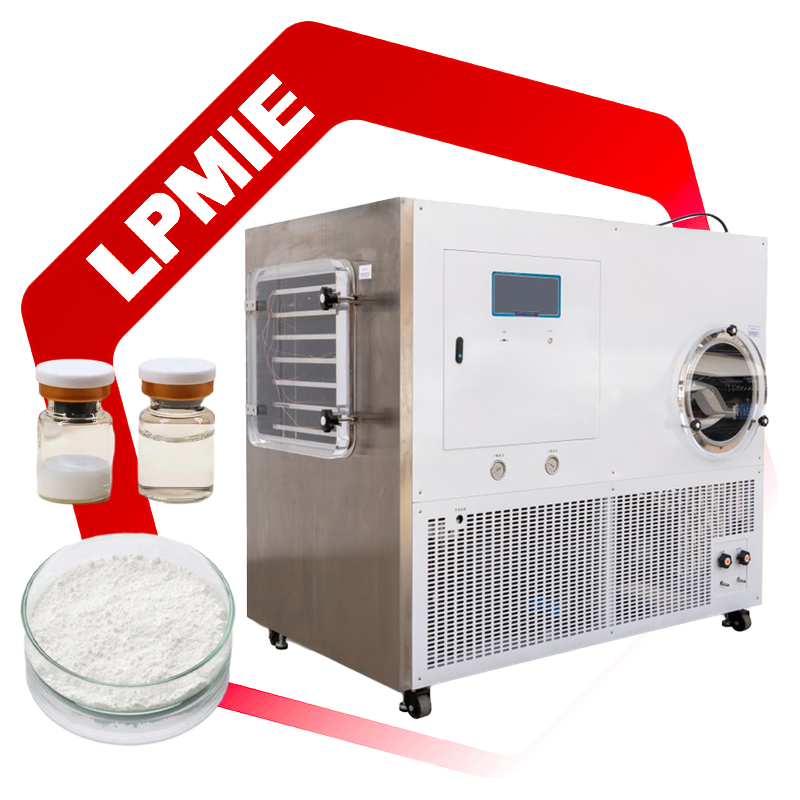
LPMIE pilot vacuum freeze dryers are designed for pilot-scale processing of liquid, paste, and solid materials. The silicone oil heating system supports uniform shelf temperature control and in-situ pre-freezing and drying.
  • ModelLGJ-50/100/200
  • Description Technical Specifications Buying Guide & Support
    Description

    Product Overview

    The LPMIE Pilot Vacuum Freeze Dryer – Standard Type is designed for pilot-scale freeze-drying of liquid, paste, and solid materials. It uses a silicone oil heating system to provide controlled shelf heating and cooling during the freeze-drying process.

    With a square chamber design, the equipment supports in-situ pre-freezing and drying without transferring materials between separate units. It is suitable for process development, product testing, and small-batch production in pharmaceutical, biotechnology, food, and chemical industries.

    Video

    Why Choose the Pilot Vacuum Freeze Dryer?

    l Silicone Oil Shelf Heating: Provides controlled shelf heating and cooling for freeze-drying processes.

    l In-Situ Pre-Freezing and Drying: Materials can be pre-frozen and dried in the same chamber.

    l Uniform Temperature Control: Designed to reduce shelf temperature differences and support consistent drying.

    l Reliable Refrigeration System: Uses branded compressor components for stable refrigeration performance.

    l Flexible Process Configuration: Optional functions can be selected according to process requirements.

    Silicone oil heated general type freeze dryer

    Typical Applications

    l Pharmaceutical intermediates and preparations

    l Biological materials and laboratory samples

    l Food ingredients, fruits, and functional foods

    l Chemical and heat-sensitive materials

    l Pilot-scale process development and testing


    Working Principle

    The material is placed on the shelves inside the chamber and frozen under controlled low-temperature conditions. The system then reduces chamber pressure to create a vacuum environment. Ice in the frozen material sublimates directly into vapor, which is captured by the cold trap. Shelf temperature and vacuum conditions are controlled throughout the process to support product drying.

    Technical Specifications

    Technique parameter

    Parameter

    LPJ-50

    LPJ-100

    LPJ-200

    Freeze-drying area (m²)

    0.7

    1.03

    2.25

    Shelf size (mm)

    480 × 360

    480 × 360

    900 × 500

    Shelf layers

    4+1

    6+1

    5+1

    Shelf temperature range (°C)

    -55 to +70; optional ranges available

    Cold trap temperature (°C)

    ≤ -75 / ≤ -85 / ≤ -110 (no load)

    Water trapping capacity (kg/24h)

    ≥10

    ≥15

    ≥30

    Installed power (kW)

    5.5

    6.5

    13.5

    Material capacity at 10 mm thickness

    7

    10

    22.5

    Power supply

    3-phase, 5-wire, 380 V

    Overall dimensions (mm)

    1662 × 790 × 1450

    1735 × 930 × 1633

    2008 × 1180 × 1730

    Weight (kg)

    600

    700

    1200

    Optional Configurations

    Optional configurations can be selected according to material characteristics and process requirements. Please contact LPMIE to confirm the available configuration for your selected model.

    Buying Guide & Support

    How to Choose the Pilot Freeze Dryer?

    Select the model according to required drying area, batch size, material characteristics, and expected production frequency. For vial stoppering, consider the Pilot Gland Type. For a water-cooled configuration, refer to the Water-Cooled Pilot Vacuum Freeze Dryer.

    FAQ

    1. What materials can this pilot freeze dryer process?
    It is suitable for liquid, paste, and solid materials that require vacuum freeze-drying.

    2. Does the machine support in-situ pre-freezing?
    Yes. The square chamber design supports pre-freezing and drying in the same chamber.

    3. What is the heating medium?
    The shelves use silicone oil as the heating and cooling medium.

    4. Can the system be customized?
    Optional functions and configurations can be discussed according to the material and process requirements.

    Send your message to us
    ver_code