The ZP17B Rotary Tablet Press is designed for manufacturing large-diameter tablets requiring high compression force and stable operation. Available in 15-station and 17-station models, it is widely used for pharmaceutical, chemical and food applications involving large or difficult-to-form tablets.
Featuring a robust mechanical structure, variable-frequency speed control and high compression capacity, the machine provides stable tablet weight, thickness and hardness during continuous production. The enclosed stainless steel construction complies with GMP requirements and simplifies cleaning and maintenance.
The ZP17B Series is particularly suitable for producing large tablets, catalyst tablets, disinfectant tablets, veterinary tablets and other products requiring higher compression force than standard rotary tablet presses.

l High Compression Force
l Large Tablet Capability
l Variable Frequency Speed Control
l Suitable for Difficult Formulations
l Continuous Rotary Production
l GMP-Compliant Construction

Turret speed can be adjusted continuously to match different production requirements.
Compression parameters can be fine-tuned during operation, reducing downtime and improving production efficienc
The heavy-duty compression system delivers stable pressure for large tablets and difficult formulations.
Robust transmission components ensure smooth operation, long service life and consistent tablet quality.
Ideal for producing large-diameter tablets, veterinary tablets, catalyst tablets and other difficult-to-form products.

|
Industry |
Typical Products |
|
Pharmaceutical |
Tablets, OTC medicines |
|
Nutraceutical |
Vitamins, Minerals |
|
Food |
Candy Tablets, Milk Tablets |
|
Chemical |
Catalyst Tablets, Cleaning Tablets |
|
Education |
Laboratory Demonstration |
The ZP17B Rotary Tablet Press operates through a continuous rotary compression process. Powder or granules are fed into the die cavities as the turret rotates. The upper and lower punches apply high compression force to form tablets, which are then automatically ejected. The machine is designed to maintain stable compression pressure for large-diameter and difficult-to-form tablets.
|
Model |
ZP15B |
ZP17B |
|
Stations |
15 |
17 |
|
Max. Pressure (kN) |
150 |
120 |
|
Max. Tablet Diameter (mm) |
40 |
36 |
|
Max. Filling Depth (mm) |
25 |
30 |
|
Max. Tablet Thickness (mm) |
8–15 |
8–15 |
|
Turret Speed (rpm) |
10–25 |
10–25 |
|
Production Capacity (tablets/h) |
22,500 |
25,500 |
|
Motor Power (kW) |
7.5 |
7.5 |
|
Machine Size (mm) |
900 × 800 × 1640 |
900 × 800 × 1640 |
|
Weight (kg) |
1500 |
1500 |
l One main machine with force feeder
l One set of round dies (customizable patterns and shapes available)
l One set of routine maintenance tools
Generally speaking, the following parameters need to be confirmed for model selection:
① Confirm whether your powder is suitable for tableting.
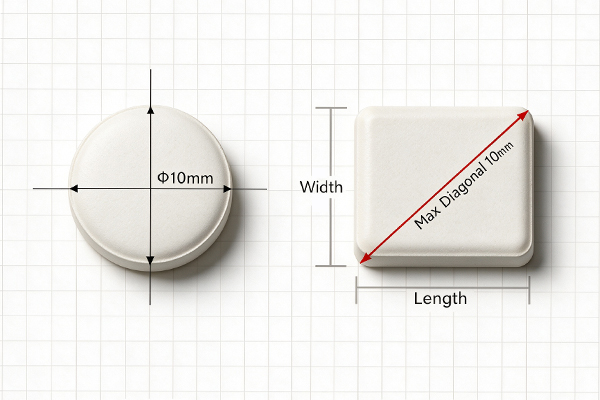
② Diameter of round tablets (the maximum diagonal length shall be provided for special-shaped tablets).
③ Required tablet thickness.
④ Required production capacity.
|
Equipment |
Function |
|
Uniform powder mixing |
|
|
Vacuum Feeder |
Automatic powder feeding |
|
Tablet Press |
Tablet compression |
|
Remove tablet dust |
|
|
Metal contamination detection |
|
|
Automatic tablet counting |
|
Material |
Suitable |
|
Pharmaceutical Granules |
✔ |
|
Vitamin Powder |
✔ |
|
Calcium Carbonate |
✔ |
|
Herbal Extract Powder |
✔ |
|
Effervescent Granules |
✔ |
|
Candy Powder |
✔ |
|
Veterinary Formulations |
✔ |
1. Dry Powder
Raw materials must be fully dry, with moisture content controlled below 5%.
2. Flowability
Materials shall have good flow performance. The ideal particle fineness for tableting ranges from 20 to 60 mesh, with a small proportion of fine powder mixed in for optimal results. If the material has poor flowability, granulation treatment is recommended. For detailed operations, please refer to our Granulation Guide.
3. Adhesiveness
Adhesiveness refers to the property that powder can agglomerate and bond together under external pressure. Materials lacking natural adhesiveness need binders to improve forming performance, such as maltodextrin, sugar, starch, microcrystalline cellulose, etc.
4. Low Oil Content
Excessive oil inside raw materials will severely hinder tableting forming. Therefore, the material cannot contain high levels of grease.
Q1: What tablet sizes can the ZP17B produce?
A1: The machine supports tablets up to 40 mm in diameter, making it suitable for large tablet applications.
Q2: What is the difference between the 15-station and 17-station models?
A2: The 15-station model provides higher compression force, while the 17-station model offers higher production capacity.
Q3: Can the machine compress difficult formulations?
A3: Yes. The ZP17B is specifically designed for large and difficult-to-form tablets requiring higher compression pressure.
Q4: Is the turret speed adjustable?
A5: Yes. The machine is equipped with a variable-frequency drive, allowing flexible speed adjustment according to production requirements.
Q6: What industries is this machine suitable for?
A6: It is widely used in pharmaceutical, chemical, veterinary and food industries for manufacturing large tablets.
l Tablet Tooling Guide for Abrasive and Sticky Powders
l Tablet Press Tooling Maintenance: Anti-Rust Guide